
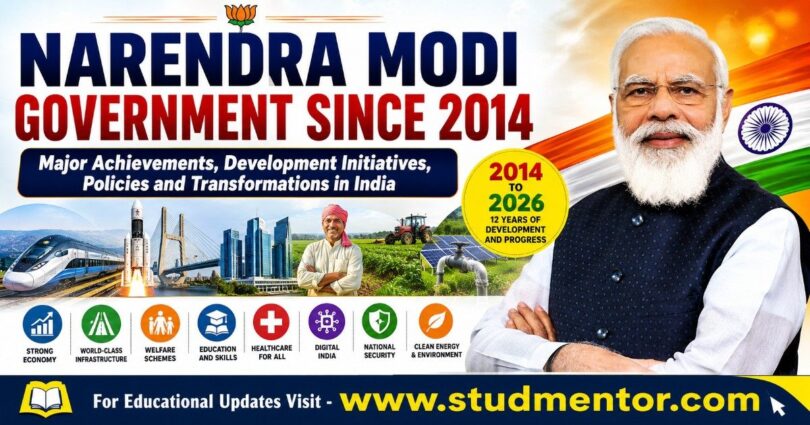

In this article we providing information regarding latest Narendra Modi Government Since 2014: Major Achievements, Development Initiatives, Policies and Transformations in India
Narendra Modi Government Since 2014: Major Achievements, Development Initiatives, Policies and Transformations in India
Introduction
On 26 May 2014, Narendra Modi took the oath of office as the 14th Prime Minister of India. His government began its first term with the vision of building a developed, prosperous, digitally empowered and self-reliant India. The government introduced several national programmes focusing on economic development, infrastructure, social welfare, education, healthcare, agriculture, national security and technological advancement.
The Modi-led government returned to power in 2019 for its second term and again in 2024 for its third term. Since 2014, several major initiatives and policy changes have influenced India’s development and governance.
The government’s stated guiding principles include Sabka Saath, Sabka Vikas, Sabka Vishwas and Sabka Prayas.
1. Financial Inclusion and Economic Development
One of the major initiatives introduced in 2014 was the Pradhan Mantri Jan Dhan Yojana (PMJDY). It aimed to provide banking facilities to people who previously had limited access to formal banking services.
Major initiatives include:
- Pradhan Mantri Jan Dhan Yojana (2014): Financial inclusion through bank accounts.
- Make in India (2014): Encouraging manufacturing and investment in India.
- Digital India (2015): Promoting digital services and digital infrastructure.
- Startup India (2016): Supporting entrepreneurship and startups.
- Stand-Up India (2016): Promoting entrepreneurship among women and SC/ST communities.
- Goods and Services Tax (GST, 2017): Introduced a unified indirect tax framework across India.
- Pradhan Mantri Mudra Yojana (2015): Providing institutional loans to micro and small businesses.
- Production Linked Incentive (PLI) Schemes: Encouraging domestic manufacturing in selected sectors.
These initiatives aim to strengthen the economy, encourage entrepreneurship, improve financial access and promote domestic production.
2. Infrastructure and Transportation Development
Infrastructure development has been an important focus of the Modi government. Significant investments have been made in national highways, expressways, railways, airports, ports and urban transportation.
Important developments include:
- Expansion of the National Highway network.
- Development of modern expressways and economic corridors.
- Introduction and expansion of Vande Bharat Express trains.
- Railway electrification and modernization of railway stations.
- Expansion of metro rail services in Indian cities.
- UDAN scheme to improve regional air connectivity.
- Bharatmala Pariyojana for highway development.
- PM Gati Shakti National Master Plan for coordinated infrastructure planning.
- Development of modern railway stations under the Amrit Bharat Station Scheme.
These projects are intended to improve connectivity, reduce transportation time, support trade and create opportunities for economic growth.
3. Welfare Schemes for Poor and Middle-Class Families
The government introduced several welfare programmes to improve access to basic facilities and social security.
Some major schemes are:
- Pradhan Mantri Ujjwala Yojana (2016): LPG connections for eligible women from poor households.
- Pradhan Mantri Awas Yojana (2015): Affordable housing for eligible rural and urban families.
- Swachh Bharat Mission (2014): Improving sanitation and cleanliness.
- Saubhagya Yojana (2017): Household electricity connections.
- Jal Jeevan Mission (2019): Providing tap-water connections to rural households.
- Ayushman Bharat (2018): Health coverage for eligible beneficiaries under PM-JAY.
- PM Garib Kalyan Anna Yojana: Free food grains for eligible beneficiaries.
- PM SVANidhi (2020): Working-capital loans for eligible street vendors.
These schemes focus on housing, sanitation, clean cooking fuel, drinking water, electricity, food security and healthcare.
4. Development of Agriculture and Farmers’ Welfare
Agriculture remains an important part of India’s economy. The government introduced several initiatives for farmers and rural communities.
Important programmes include:
- PM-KISAN (2019): Financial assistance to eligible farmer families.
- Pradhan Mantri Fasal Bima Yojana (2016): Crop insurance for farmers.
- Soil Health Card Scheme (2015): Information about soil health and nutrient requirements.
- e-NAM (2016): Electronic National Agriculture Market.
- PM Krishi Sinchai Yojana (2015): Improving irrigation facilities.
- Agriculture Infrastructure Fund (2020): Supporting agricultural infrastructure.
- PM-KUSUM (2019): Promoting solar energy in agriculture.
The objective of these programmes is to improve agricultural productivity, support farmers’ incomes, reduce agricultural risks and strengthen rural infrastructure.
5. Education and Skill Development
Education and skill development have received attention through several national programmes and policy reforms.
Major initiatives include:
- National Education Policy (NEP) 2020: Introducing reforms in school and higher education.
- Samagra Shiksha Abhiyan: Supporting school education from pre-primary to senior secondary levels.
- PM SHRI Schools (2022): Developing selected schools as model institutions aligned with NEP 2020.
- PM eVIDYA: Promoting digital and online education.
- DIKSHA Platform: Providing digital educational resources for teachers and students.
- Skill India Mission (2015): Developing vocational and employment-related skills.
- Pradhan Mantri Kaushal Vikas Yojana: Providing skill training to eligible youth.
- Atal Innovation Mission: Encouraging innovation, creativity and entrepreneurship among students.
These programmes aim to improve educational quality, promote technology-based learning and prepare students for future opportunities.
6. Healthcare and Medical Facilities
Healthcare infrastructure and access to medical services have been important areas of government policy.
Major initiatives include:
- Ayushman Bharat – Pradhan Mantri Jan Arogya Yojana.
- Ayushman Arogya Mandirs.
- Expansion of AIIMS institutions.
- Pradhan Mantri Bhartiya Janaushadhi Pariyojana.
- Mission Indradhanush for vaccination.
- National Health Mission.
- National Sickle Cell Anaemia Elimination Mission.
- Digital health initiatives under the Ayushman Bharat Digital Mission.
During the COVID-19 pandemic, India conducted a nationwide vaccination programme and supplied vaccines to several countries through its vaccine diplomacy initiatives.
7. Digital India and Technological Development
India has witnessed significant growth in digital public infrastructure and online services.
Important initiatives include:
- Digital India Programme (2015).
- Unified Payments Interface (UPI).
- Aadhaar-enabled service delivery.
- BharatNet for rural broadband connectivity.
- DigiLocker for digital documents.
- UMANG for government services.
- Government e-Marketplace (GeM).
- Direct Benefit Transfer (DBT).
- IndiaAI Mission (2024).
Digital payment systems have made electronic transactions more accessible. UPI has become an important part of India’s digital payment ecosystem, while online government platforms have simplified access to various public services.
8. National Security and Defence Modernisation
The government has undertaken several measures relating to defence production, military infrastructure and national security.
Important developments include:
- Modernisation of the armed forces.
- Promotion of domestic defence manufacturing.
- Defence industrial corridors in Uttar Pradesh and Tamil Nadu.
- Increased participation of private companies in defence production.
- Expansion of indigenous defence equipment manufacturing.
- Appointment of the Chief of Defence Staff in 2019.
- Introduction of Agnipath recruitment scheme in 2022.
- Development of border infrastructure and strategic roads.
The government has also emphasised reducing dependence on imported defence equipment and promoting the domestic defence industry.
9. Women Empowerment and Social Development
Several schemes have been introduced to support women, girls and disadvantaged sections of society.
Important initiatives include:
- Beti Bachao, Beti Padhao (2015).
- Sukanya Samriddhi Yojana (2015).
- Pradhan Mantri Ujjwala Yojana.
- Stand-Up India.
- Mission Shakti.
- Nari Shakti initiatives.
- Namo Drone Didi Scheme.
- Nari Shakti Vandan Adhiniyam (2023), providing for reservation of seats for women in the Lok Sabha and State Legislative Assemblies, subject to the constitutional implementation conditions.
These initiatives address women’s education, financial inclusion, entrepreneurship, safety and political representation.
10. Major Constitutional and Legislative Decisions
During the Modi government’s tenure, several significant constitutional and legislative changes took place.
Some important developments include:
- Article 370 (2019): Constitutional changes concerning the special status of Jammu and Kashmir and reorganisation of the former state into two Union Territories.
- Citizenship Amendment Act (2019): Amendment to citizenship provisions for specified religious minorities from three neighbouring countries, subject to the law’s conditions.
- Triple Talaq Law (2019): Legislation making instant triple talaq void and illegal.
- New Criminal Laws (2023): Bharatiya Nyaya Sanhita, Bharatiya Nagarik Suraksha Sanhita and Bharatiya Sakshya Adhiniyam replaced the previous central criminal law framework from 1 July 2024.
- Women’s Reservation Act (2023): Constitutional amendment providing for one-third reservation for women in the Lok Sabha and State Legislative Assemblies, subject to the prescribed process.
These decisions have had significant legal, administrative and political implications and have generated public discussion and differing viewpoints.
11. International Relations and India’s Global Role
India’s international engagement has expanded through diplomatic partnerships, economic cooperation, strategic relationships and participation in international organisations.
Major developments include:
- India’s G20 Presidency in 2023.
- Strengthening relations with the United States, Japan, France, Australia and other strategic partners.
- Greater engagement with neighbouring countries through regional cooperation.
- International Solar Alliance.
- Participation in BRICS, SCO and QUAD-related cooperation.
- Expansion of international trade and investment partnerships.
- Promotion of Yoga and International Yoga Day, observed globally on 21 June.
The G20 Summit hosted by India in 2023 brought international attention to India’s role in global discussions on economic development, climate change, technology and international cooperation.
12. Science, Space Research and Innovation
India’s scientific and technological capabilities have continued to develop through space missions, research programmes and innovation initiatives.
Important milestones include:
- Chandrayaan-3’s successful landing near the lunar south polar region in August 2023.
- Aditya-L1 solar observation mission.
- Gaganyaan human spaceflight programme.
- Development of indigenous semiconductor manufacturing capabilities.
- Expansion of startups and innovation ecosystems.
- National Quantum Mission.
- IndiaAI Mission.
- Promotion of research and development through national programmes.
The Chandrayaan-3 mission was a major milestone for India’s space programme and demonstrated the capabilities of ISRO.
13. Environment, Renewable Energy and Clean Energy
The government has introduced various initiatives to promote renewable energy and environmental sustainability.
Major initiatives include:
- International Solar Alliance.
- National Solar Mission.
- PM Surya Ghar: Muft Bijli Yojana (2024).
- National Green Hydrogen Mission (2023).
- Swachh Bharat Mission.
- National Clean Air Programme.
- Promotion of electric mobility.
- Mission LiFE (Lifestyle for Environment).
These programmes aim to increase clean energy production, improve environmental awareness and support India’s climate commitments.
14. Major Challenges and Areas Requiring Continued Attention
A balanced assessment of any government should also examine its challenges and areas where further progress is required.
Some important issues include:
- Creation of sufficient quality employment opportunities.
- Controlling inflation and improving household purchasing power.
- Reducing economic inequality.
- Improving the quality of government schools and public healthcare.
- Supporting small businesses and farmers.
- Addressing air pollution and environmental challenges.
- Improving women’s workforce participation.
- Strengthening urban infrastructure and public services.
Although several national programmes have expanded access to essential services, their implementation and outcomes can differ across states, districts and communities. Continuous monitoring, transparency and effective delivery remain important.
Conclusion
Since May 2014, the Narendra Modi-led Union Government has introduced a wide range of policies and programmes covering infrastructure, financial inclusion, digital technology, education, healthcare, agriculture, defence, social welfare and international relations.
Initiatives such as Digital India, Swachh Bharat Mission, Jan Dhan Yojana, Ayushman Bharat, PM-KISAN, Jal Jeevan Mission, PM Awas Yojana and PM Gati Shakti have become significant parts of India’s development policy framework.
At the same time, the country’s future development requires sustained attention to employment, education quality, healthcare, economic opportunities, social inclusion and environmental sustainability.
The broader national objective of Viksit Bharat 2047 is to build a developed India by the 100th anniversary of independence. Achieving this vision will require effective governance, public participation, institutional accountability and collective efforts from citizens, governments and communities.
A developed nation is built not only through government policies but also through the active participation, responsibility and contribution of its citizens.
Thanks to Beloved Readers.