
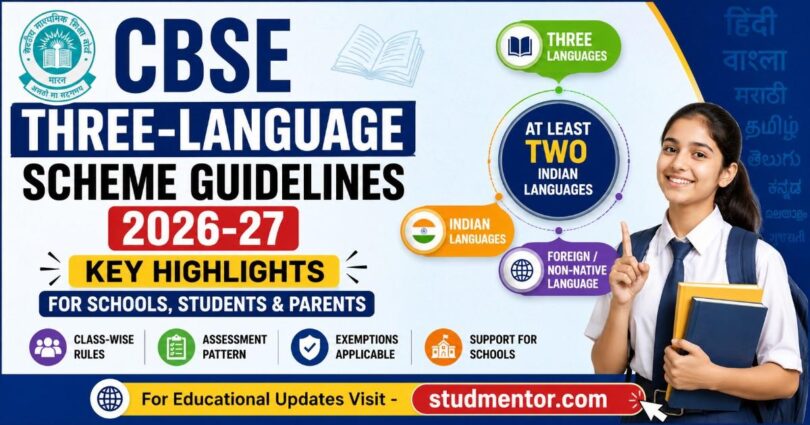

Know CBSE Three-Language Scheme 2026-27, eligibility, assessment rules, exemptions, and class-wise changes.
CBSE Three-Language Scheme Guidelines 2026-27: Key Highlights for Schools, Students & Parents
The Central Board of Secondary Education (CBSE) has issued Circular No. Acad-49/2026 dated 10 July 2026, introducing detailed guidelines for implementing the Three-Language Scheme in CBSE-affiliated schools from the 2026-27 academic session. The policy aligns with the National Education Policy (NEP) 2020 and aims to promote multilingual learning while ensuring a smooth transition for students.
Major Highlights
1. Two Indian Languages are Mandatory
- Every student will study three languages.
- At least two of the three languages must be Bhartiya Bhashas (Indian languages).
- A foreign/non-native language such as English, French, German, Arabic or Spanish can be chosen as the third language only if the other two are Indian languages.
Class-wise Implementation
Class X (2026-27)
- No change for the current Class X batch.
- Students will continue with the existing two-language system.
- No third language is required.
Class IX (2026-27)
- Three-language scheme becomes applicable.
- Students already studying:
- Two Indian languages may choose another Indian language or a foreign language as the third language.
- One Indian + one foreign language must select an additional Indian language.
- Two foreign languages receive a one-time relaxation and only need to add one Indian language.
Assessment Pattern
- The third language (R3) will be assessed only by the school through internal assessment.
- No CBSE Board Examination for the third language for the current Class IX and subsequent transitional batches.
- Students must pass the school-based assessment to receive the CBSE Class X Pass Certificate. Schools will provide reassessment opportunities if required.
For Classes VII & VIII (2026-27)
- Students will continue with three languages while ensuring two are Indian languages.
- Those already studying two foreign languages must add one Indian language and continue it until Class X.
- Assessment will remain school-based.
For Class VI (2026-27) Onwards
- The policy will be fully implemented.
- Students must study two Indian languages among the three.
- These batches will eventually appear for the CBSE Board Examination in the third language when they reach Class X.
Exemptions
The Three-Language Scheme provides exemptions for:
- Children with Special Needs (CwSN) as per the RPwD Act, 2016.
- CBSE schools located outside India.
- Foreign students returning to India.
- Students whose parents migrate to another state may continue their existing language combination.
Support for Schools
CBSE has allowed flexible staffing through existing teachers, retired teachers, postgraduate language experts, Sahodaya school clusters, and virtual or hybrid teaching methods. The Board has also assured schools of learning resources, capacity building, and continuous support for smooth implementation.
Conclusion
The new guidelines focus on strengthening multilingual education while protecting student interests during the transition. CBSE has clarified that the objective is to make language learning joyful, meaningful, and culturally enriching, rather than increasing examination pressure