
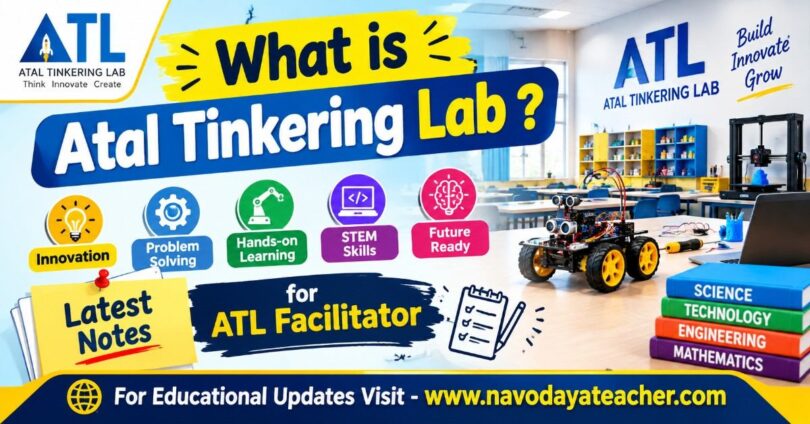

In this article we providing information regarding latest What is Atal Tinkering Lab ? Latest Notes for ATL Facilitator .
What is Atal Tinkering Lab ? Latest Notes for ATL Facilitator
1. What is Atal Tinkering Lab?
Atal Tinkering Lab (ATL) is an innovation and creativity workspace established in schools under the Atal Innovation Mission (AIM) of NITI Aayog.
The main purpose of ATL is to provide school students with a hands-on learning environment where they can:
- Think creatively
- Identify real-life problems
- Develop innovative ideas
- Design and build prototypes
- Experiment with technology
- Learn from failures
- Develop problem-solving skills
- Create solutions for society
In simple words:
ATL is a school laboratory where students learn by creating, experimenting, designing and solving real-world problems.
2. What is Atal Innovation Mission (AIM)?
Atal Innovation Mission (AIM) is a flagship initiative of NITI Aayog designed to promote a culture of innovation and entrepreneurship in India.
ATL is one of the important initiatives under AIM.
Main objective of AIM
AIM aims to develop an ecosystem in which students and young people can become:
- Innovators
- Problem solvers
- Entrepreneurs
- Technology creators
3. Why were Atal Tinkering Labs introduced?
Traditional classroom learning often focuses mainly on theoretical knowledge.
ATL provides students with opportunities to apply their classroom knowledge practically.
For example:
A student may learn about electricity in Science class. In an ATL, the student can use that knowledge to:
Think → Design → Build → Test → Improve
a working device or prototype.
Thus, ATL helps bridge the gap between:
Theoretical Learning + Practical Application
4. Objectives of Atal Tinkering Lab
The major objectives are:
1. Develop Creativity
Students are encouraged to think of new and different solutions to existing problems.
2. Develop Curiosity
Students learn by asking questions such as:
- Why does this happen?
- How does this work?
- Can we make it better?
- Can we make it automatic?
3. Develop Problem-Solving Skills
Students learn to identify a problem and develop possible solutions.
4. Promote Innovation
ATL encourages students to convert their ideas into working models and prototypes.
5. Encourage Experimentation
Students can experiment with different components, technologies and ideas.
6. Learn from Failure
Failure is considered an important part of the innovation process.
A failed prototype helps students understand:
What did not work, why it did not work, and how it can be improved.
5. What does “Tinkering” mean?
Tinkering means experimenting with something in order to understand it, modify it or improve it.
In an ATL, students may:
- Open and examine things
- Assemble components
- Modify existing designs
- Build prototypes
- Test their ideas
- Find mistakes
- Improve their models
Therefore, tinkering is basically learning through experimentation and making.
6. What can students learn in ATL?
ATL exposes students to several modern technologies.
Important areas include:
Electronics
Students can learn about:
- Sensors
- LEDs
- Motors
- Circuits
- Microcontrollers
- Electronic components
Robotics
Students can design and build simple robots using motors, sensors and controllers.
Internet of Things (IoT)
Students can learn how physical devices can communicate and exchange information through the internet.
3D Printing
Students can convert digital designs into physical objects using a 3D printer.
Artificial Intelligence
Students can explore basic applications of AI and intelligent systems.
Coding & Programming
Students can develop computational thinking and create programs to control devices and solve problems.
Sensors and Automation
Students can use sensors to detect:
- Temperature
- Light
- Motion
- Distance
- Sound
- Gas and other conditions
7. ATL Learning Cycle
A typical innovation process can be understood through the following cycle:
Identify Problem
↓
Understand the Problem
↓
Generate Ideas
↓
Design Solution
↓
Build Prototype
↓
Test
↓
Find Problems
↓
Improve
↓
Final Solution
This process teaches students that innovation is not completed in a single attempt.
8. Prototype
A prototype is an early model or working version of a product or solution.
For example:
Suppose students want to develop a system that automatically switches on a light when someone enters a room.
They can create a small working model using:
- Motion sensor
- Microcontroller
- LED/bulb
- Connecting wires
- Power supply
This first working model is a prototype.
After testing it, students can improve the design.
9. ATL and Design Thinking
ATL encourages students to use a design-thinking approach.
A simplified design-thinking process is:
Empathize
Understand the needs of people.
Define
Clearly identify the problem.
Ideate
Think of multiple possible solutions.
Prototype
Build a model of the solution.
Test
Try the prototype and collect feedback.
Improve
Modify the solution based on the results.
10. Role of Students in ATL
Students are the main participants in ATL activities.
They should:
- Ask questions
- Explore ideas
- Work in teams
- Experiment
- Build models
- Test prototypes
- Document their work
- Accept failure
- Improve their solutions
- Present their innovations
11. Role of ATL In-charge / Teacher
The teacher or ATL In-charge acts mainly as a facilitator and mentor.
The teacher should:
- Encourage students to experiment
- Help students understand equipment
- Ensure laboratory safety
- Guide project development
- Encourage teamwork
- Help students document their projects
- Motivate students to participate in innovation activities
The teacher does not necessarily provide every answer.
Instead, the teacher encourages students to find solutions themselves.
12. Importance of ATL
ATL helps develop important 21st-century skills.
Creativity
Ability to generate new ideas.
Critical Thinking
Ability to analyze information and situations.
Problem Solving
Ability to find solutions to problems.
Collaboration
Ability to work effectively in a team.
Communication
Ability to explain ideas and present projects.
Computational Thinking
Ability to break complex problems into smaller logical steps.
Innovation
Ability to develop useful new ideas and solutions.
13. Example of an ATL Project
Problem:
Students notice that lights in classrooms are sometimes left switched on unnecessarily.
Idea:
Create an automatic lighting system.
Components:
- Motion sensor
- Microcontroller
- LED
- Wires
- Power supply
Working:
The sensor detects movement.
If a person enters the room:
Motion detected → Controller receives signal → Light turns ON
If no movement is detected for a specified period:
No movement → Controller → Light turns OFF
Through this project, students learn:
Electronics + Coding + Sensors + Automation + Problem Solving
14. ATL is more than a Laboratory
An ATL should not be treated simply as another school laboratory.
Its purpose is to create a culture of innovation.
Students should be encouraged to:
Think → Tinker → Experiment → Fail → Learn → Improve → Innovate
The focus is not only on making a project but also on understanding the process of innovation.
15. Important Terms
| Term | Meaning |
|---|---|
| ATL | Atal Tinkering Lab |
| AIM | Atal Innovation Mission |
| NITI Aayog | Government of India’s policy think tank |
| Tinkering | Experimenting, modifying and improving things |
| Innovation | Creating or improving ideas, products or solutions |
| Prototype | Initial model of a product or solution |
| IoT | Internet of Things |
| AI | Artificial Intelligence |
| Robotics | Technology involving design and use of robots |
| 3D Printing | Creating physical objects from digital designs |
| Mentor | Person who guides learners |
| Design Thinking | Problem-solving approach focused on users and iterative improvement |
16. Key Takeaways
- ATL stands for Atal Tinkering Lab.
- ATL is an initiative under Atal Innovation Mission (AIM).
- AIM is associated with NITI Aayog.
- ATL promotes creativity, innovation and problem-solving among school students.
- Tinkering means experimenting and modifying things to learn or improve them.
- ATL promotes hands-on and experiential learning.
- Students can work with technologies such as robotics, IoT, AI, electronics, sensors, coding and 3D printing.
- Students are encouraged to learn from failure.
- A prototype is an initial model of a solution or product.
- ATL helps develop important 21st-century skills.
- Teachers primarily act as facilitators and mentors.
- The ultimate aim is to develop a culture of innovation among students.
One-Line Definition for Exam
Atal Tinkering Lab (ATL) is a school-based innovation workspace under the Atal Innovation Mission that enables students to develop creativity, curiosity and problem-solving skills through hands-on experimentation and technology-based tinkering.