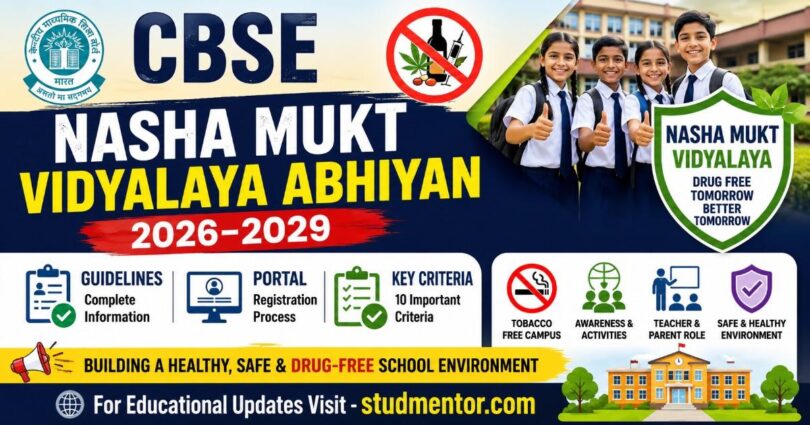

In this article we providing information regarding latest CBSE Nasha Mukt Vidyalaya Abhiyan 2026–2029: Guidelines, Portal Registration and Key Criteria.
CBSE Nasha Mukt Vidyalaya Abhiyan 2026–2029: Guidelines, Portal Registration and Key Criteria
The Central Board of Secondary Education (CBSE) has issued Circular No. Acad-55/2026 dated 17 August 2026 regarding the implementation of the “Nasha Mukt Vidyalaya Abhiyan” and registration on the Nasha Mukt Vidyalaya (NMV) Portal.
The initiative has been developed by the Department of School Education & Literacy (DoSEL), Ministry of Education, Government of India, with the objective of creating safe, healthy, tobacco-free and drug-free educational institutions.
What is Nasha Mukt Vidyalaya Abhiyan?
The Nasha Mukt Vidyalaya Abhiyan is a three-year action plan for 2026–2029 aimed at making educational institutions drug-free.
The programme focuses on:
- Drug-free schools
- Tobacco-free educational institutions
- Student awareness and behavioural change
- Teacher and parent capacity building
- Community participation
- Prevention and counselling
The target is to achieve 100% Tobacco-Free Educational Institution (ToFEI) compliance and drug-free educational institutions by 2029.
Nasha Mukt Vidyalaya Portal
The Nasha Mukt Vidyalaya Portal has been launched to support registration, self-assessment and monitoring of schools.
Schools affiliated with CBSE are requested to:
- Register on the NMV Portal.
- Complete the online self-evaluation.
- Implement the required tobacco-free and drug-free measures.
- Conduct awareness and preventive education activities.
- Engage parents and the community.
- Maintain records for monitoring and verification.
Schools that fulfil the prescribed criteria may declare themselves as “Nasha Mukt Vidyalaya”. The Department of School Education & Literacy may conduct random physical verification of such declarations.
500-Metre Drug-Free Zone
One of the major interventions under the action plan is the declaration of a 500-metre radius around educational institutions as a Drug-Free Zone.
Schools are expected to display appropriate signage and report violations involving the sale or consumption of drugs to the concerned police and narcotic law-enforcement agencies.
Tobacco-Free School Requirements
The action plan also focuses strongly on tobacco-free educational institutions.
The circular states that tobacco products should not be sold within 100 yards of an educational institution, in accordance with the applicable provisions of COTPA, 2003.
Schools should also ensure that their campuses remain free from tobacco waste, drug-related substances, alcohol traces and spitting marks.
Ten Criteria for Nasha Mukt Vidyalaya
Schools are expected to work towards the following 10 criteria:
- Comprehensive tobacco-free signage within the campus
- Display of responsible authority/reporting officer details
- Tobacco-Free Educational Institution identity
- Declaration of a 500-metre Drug-Free Zone
- Clean and substance-free campus
- Awareness and information displays
- Regular awareness activities
- Designation of Nasha Mukt Vidyalaya Monitors
- Institutional policy integration
- Compliance with the 100-yard tobacco-sale regulation and enforcement
Awareness Programmes in Schools
Schools should regularly organise activities to create awareness among students about the harmful effects of tobacco, drugs and substance abuse.
The action plan calls for at least one awareness programme every six months on tobacco, drugs or substance abuse.
Schools can also use posters, charts, handbooks, documentaries, awareness films and other IEC (Information, Education and Communication) materials.
Role of Teachers and Parents
Teacher and parent participation is an important part of the programme.
Teachers are expected to receive capacity-building support to help them:
- Identify students at risk
- Provide appropriate guidance and support
- Promote tobacco-free and drug-free school practices
- Support prevention and awareness activities
The plan also proposes teacher training modules and regular in-service training related to substance-abuse prevention.
Important Activities for Schools
Schools should focus on:
- Tobacco-free and drug-free campus
- Awareness campaigns
- Parent engagement
- Student counselling and guidance
- Teacher training
- Appropriate signage
- Regular monitoring
- Participation in national awareness initiatives
- Maintaining records and evidence of activities
The action plan also highlights the observance of World No Tobacco Day on 31 May and the International Day Against Drug Abuse and Illicit Trafficking on 26 June every year.
National Pledge and MyGov Quiz
CBSE has advised schools to encourage students and other members of the school community to participate in the National Pledge against Drug Abuse.
Schools are also encouraged to participate in the Ministry of Education’s MyGov Quiz related to the International Day Against Drug Abuse and Illicit Trafficking.
Key Takeaway for CBSE Schools
The Nasha Mukt Vidyalaya Abhiyan 2026–2029 aims to develop a safe, healthy and substance-free educational environment through awareness, prevention, teacher training, parent participation and continuous monitoring.
All CBSE-affiliated schools should register on the NMV Portal, complete the self-assessment and implement the prescribed measures for creating a tobacco-free and drug-free school environment.
Important Details at a Glance
| Particular | Details |
|---|---|
| Circular No. | Acad-55/2026 |
| Date | 17 August 2026 |
| Issued by | CBSE |
| Programme | Nasha Mukt Vidyalaya Abhiyan |
| Action Plan | 2026–2029 |
| Portal | Nasha Mukt Vidyalaya (NMV) Portal |
| Drug-Free Zone | 500-metre radius |
| Tobacco Sale Restriction | 100 yards from educational institution |
| Awareness Frequency | At least once every six months |
| Target | 100% ToFEI compliance and drug-free educational institutions by 2029 |
Official Circular
For the complete guidelines, schools should refer to the official CBSE Circular No. Acad-55/2026 issued on 17 August 2026.