
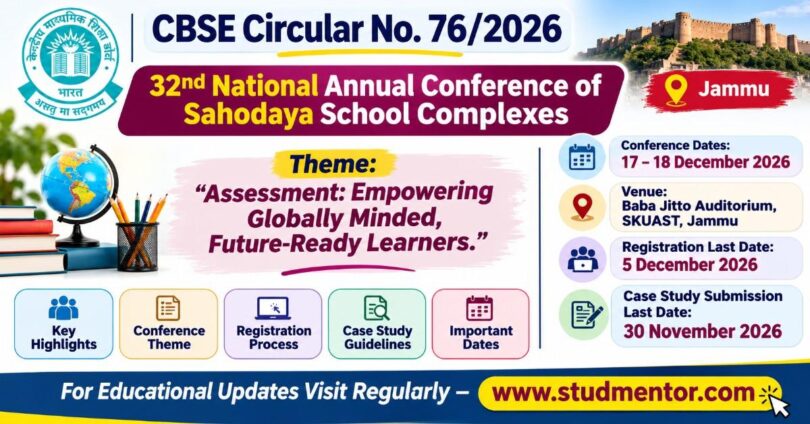

In this article we providing information regarding latest CBSE Circular 76/2026: Sahodaya Conference Dates & Registration
CBSE Circular No. 76/2026: 32nd National Annual Conference of Sahodaya School Complexes – Date, Venue, Theme, Registration & Case Study Submission
The Central Board of Secondary Education (CBSE) has issued Circular No. Acad-76/2026 dated 9 November 2026 regarding the 32nd National Annual Conference of Sahodaya School Complexes – 2026.
The national-level conference will be organised on 17 and 18 December 2026 in Jammu in collaboration with Jammu Sahodaya School Complex. The main theme of this year’s conference is “Assessment: Empowering Globally Minded, Future-Ready Learners.”
The conference will focus on improving the assessment system in schools, promoting competency-based learning, using technology in student assessment and encouraging innovative teaching and evaluation practices.
CBSE has also invited schools to submit case studies highlighting their best practices and successful educational initiatives. Principals and teachers can contribute their experiences for possible inclusion in the conference souvenir.
1. Overview of CBSE Circular No. 76/2026
| Particulars | Details |
|---|---|
| Board | Central Board of Secondary Education (CBSE) |
| Circular Number | Acad-76/2026 |
| Circular Date | 9 November 2026 |
| Conference | 32nd National Annual Conference of Sahodaya School Complexes |
| Conference Dates | 17–18 December 2026 |
| Venue | Baba Jitto Auditorium, SKUAST, Jammu |
| Main Theme | Assessment: Empowering Globally Minded, Future-Ready Learners |
| Case Study Submission Last Date | 30 November 2026 |
| Registration Last Date | 5 December 2026 |
| Participation Fee | ₹6,000 per participant |
| Official Registration Website | https://sahodayajammu.com/nationalconference/ |
2. Main Theme of the Conference
The theme of the 32nd National Annual Conference is:
“Assessment: Empowering Globally Minded, Future-Ready Learners.”
The main objective is to bring positive changes in the way students are assessed in schools.
The conference encourages schools to move beyond traditional examinations and focus on students’ actual learning, skills, competencies and individual progress.
It highlights the importance of:
- Assessing students’ understanding rather than only memorisation.
- Developing critical thinking and problem-solving skills.
- Encouraging creativity and adaptability.
- Providing meaningful feedback to students.
- Using assessment results to improve classroom teaching.
- Preparing students to become responsible global citizens.
3. Important Sub-Themes of the Conference
The conference will discuss the following eight sub-themes:
- Competency-Based Assessment: Moving beyond rote learning towards holistic evaluation.
- Global Citizenship and 21st Century Skills: Assessing students’ global awareness, intercultural understanding and essential life skills.
- Technology in Assessment: Understanding the opportunities, challenges and ethical issues involved in using technology for student assessment.
- Inclusive and Equitable Assessment: Developing fair assessment practices for students with different learning needs.
- Formative Assessment and Feedback: Using continuous assessment, regular feedback and socio-emotional learning to support students.
- Portfolio and Project-Based Assessment: Promoting alternative methods of assessment through projects, portfolios and practical activities.
- Assessment Literacy: Improving the assessment knowledge and skills of teachers, principals and school leaders.
- Alignment with NEP 2020 and Board Examinations: Connecting classroom assessments with board examination reforms and the vision of the National Education Policy 2020.
4. CBSE Invites Case Studies from Schools
One of the important highlights of this circular is the invitation for case studies from schools.
CBSE is inviting principals and teachers to share their school’s successful practices and experiences related to the conference sub-themes.
Schools can submit case studies on the following topics:
- Implementing competency-based assessment: Challenges, strategies and impact.
- Integrating global citizenship education into classroom assessment.
- Using technology tools for fair and effective student assessment.
- Designing inclusive assessments for students with diverse learning needs.
- Strengthening formative assessment and feedback for students’ overall development.
- Portfolio and project-based assessment: Moving from traditional to authentic evaluation.
- Building assessment literacy among teachers and school leaders.
- Aligning internal assessment with board examination reforms.
Schools with innovative assessment practices and successful educational initiatives can share their experiences through these case studies.
5. Guidelines for Case Study Submission
Principals and teachers must follow the guidelines issued by CBSE while preparing their case studies.
| Particulars | CBSE Guidelines |
|---|---|
| Maximum Word Limit | 1,000 words |
| Originality | The case study must be original. Plagiarised work will not be accepted. |
| Language | Hindi or English |
| File Format | MS Word only |
| Font | Arial / Unicode (for Hindi) |
| Font Size | 12 |
| Line Spacing | 1.5 |
| Margins | 2 cm on both sides |
| Photographs | JPEG format only |
| Submission Mode | |
| Last Date | 30 November 2026 |
Important Points to Remember
- The case study should describe actual experiences, challenges or successful practices adopted by the school.
- It should identify important issues or challenges faced by schools, teachers or principals.
- It should also suggest practical strategies to address the identified challenges.
- Wherever possible, authentic primary and secondary data should be included.
- References, if any, should be mentioned at the end.
- The write-up must include the topic, contributor’s name (Principal/Teacher) and school name with address.
- Relevant photographs and supporting evidence should be attached.
- Names and confidential information should be suitably disguised wherever necessary.
Submission Email: [email protected]
Last Date for Case Study Submission: 30 November 2026
Please note that late submissions will not be accepted. Hard copies are also not accepted.
Selected best practices may be included in the e-Souvenir to be released during the conference.
6. Registration for the 32nd National Annual Conference
Principals, teachers and other eligible participants interested in attending the conference must complete their registration through the online portal maintained by the organising Jammu Sahodaya School Complex.
Registration Website: https://sahodayajammu.com/nationalconference/
Last Date for Registration: 5 December 2026
Participants are advised to complete the registration process before the deadline.
7. Conference Participation Fee
The participation fee for the conference is:
₹6,000 per participant
The fee must be paid directly to the organising Sahodaya through its official registration portal.
The participation fee collected by the host Sahodaya will be subject to a third-party audit as prescribed by CBSE.
For assistance regarding registration or payment, participants can contact:
- Contact Person: Mr. Harkirt Jij
- Mobile Number: +91 7889467465
- Email: [email protected]
8. Date and Venue of the Conference
The 32nd National Annual Conference of Sahodaya School Complexes will be organised as follows:
- Date: 17 and 18 December 2026
- Venue: Baba Jitto Auditorium
- Institution: Sher-e-Kashmir University of Agricultural Sciences and Technology (SKUAST)
- Location: Jammu
The conference is being organised in collaboration with Jammu Sahodaya School Complex.
9. Why Is This Conference Important for Teachers and Schools?
The conference provides an opportunity for school leaders and teachers to understand the changing assessment practices in school education.
It is particularly relevant in the context of competency-based education and NEP 2020.
Teachers can gain insights into:
- Preparing competency-based questions.
- Improving classroom assessment methods.
- Using projects and portfolios for evaluation.
- Providing effective feedback to students.
- Identifying individual learning needs.
- Using technology responsibly in assessment.
Schools can also learn from the successful practices followed by other institutions and develop better strategies for improving student learning outcomes.
10. Important Dates at a Glance
| Event | Important Date |
|---|---|
| CBSE Circular Issued | 9 November 2026 |
| Last Date for Case Study Submission | 30 November 2026 |
| Last Date for Registration | 5 December 2026 |
| National Conference | 17–18 December 2026 |
11. Important Links
| Description | Link |
|---|---|
| Official CBSE Circular No. 76/2026 | https://cbseacademic.nic.in/web_material/Circulars/2026/76_Circular_2026.pdf |
| Conference Registration Portal | https://sahodayajammu.com/nationalconference/ |
| Case Study Submission Email | [email protected] |
| Registration and Payment Assistance | [email protected] |
Conclusion
The 32nd National Annual Conference of Sahodaya School Complexes – 2026 is an important initiative to promote innovative assessment practices and improve the quality of school education.
CBSE has encouraged schools to share their experiences and best practices through case studies. Principals and teachers interested in contributing should prepare their original case studies and submit
